
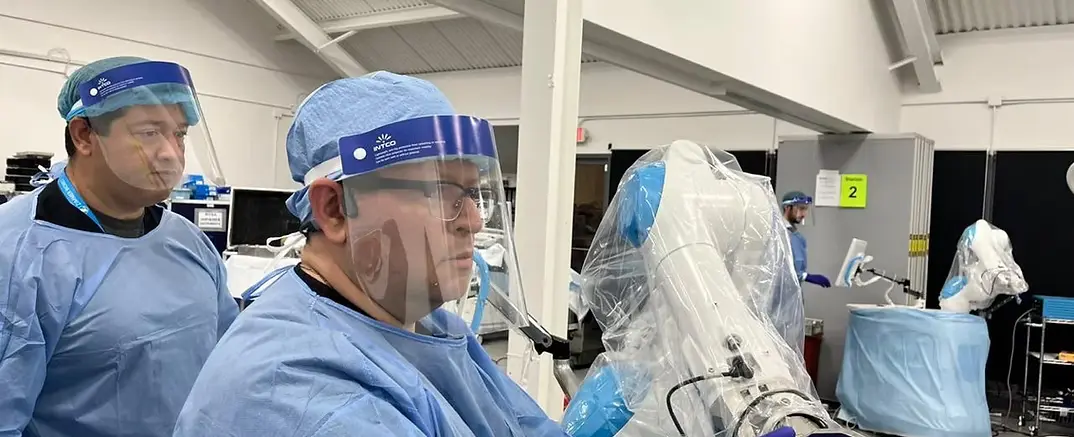
The application of Artificial Intelligence (AI) and robotic systems in joint replacement surgery is no longer a promise but has become the standard in the world's leading orthopedic centers.
In daily practice, these tools do not replace medical judgment; rather, they enhance our planning and technical execution capabilities, ensuring the prosthesis adapts to each patient's unique biomechanics.
In 30 seconds
AI analyzes preoperative imaging to generate detailed 3D models of the patient's anatomy.
The robotic arm assists in executing bone cuts with submillimeter precision, guided by the virtual plan.
This accuracy protects soft tissues and peripheral ligaments, translating into a lower postoperative inflammatory response.
A biomechanically aligned implant distributes loads better, prolonging the lifespan of the prosthesis.
Personalized preoperative planning
The main shift from conventional technique is the ability to anticipate. AI algorithms process the patient's CT scan to reconstruct an exact virtual model of the knee. This allows us to evaluate the load axis, bone density, and calculate the ideal size and positioning of the implant before entering the operating room.
Intraoperative execution and precision
During the procedure, the robotic system acts as a high-precision haptic guide. Under direct control of the surgeon, it restricts cutting instruments from exceeding the virtually planned limits. In knees with complex deformities or ligament retractions, this precision ensures proper tissue balance, which is essential for the knee to feel stable when going up or down stairs.
Impact on recovery
By minimizing trauma to soft tissues and achieving precise balance from the outset, postoperative pain tends to be lower. This facilitates accelerated rehabilitation protocols, allowing many patients to start walking with support on the same day as the surgery.
The Dr. Calderón Difference
Technology is only as effective as the team operating it. My approach integrates robotic tools and AI-assisted planning with years of experience in complex joint reconstruction, always prioritizing safety, long-term function, and the recovery of each patient.
Bottom Line
Severe osteoarthritis that limits quality of life now has highly sophisticated treatment options. Technological assistance maximizes the precision of the procedure and optimizes functional outcomes.
Book your evaluation in Quito (Edif. Fortune Plaza) to assess if you are a candidate for a robot-assisted procedure.
Medical note: educational content; the use of technology depends on individual clinical indication after medical consultation.
